Criminal Records in Bernalillo County can be accessed through the official county portal, where users perform a Bernalillo County criminal record lookup by name, case number, or date of birth to view arrest logs, offense classifications, and case dispositions. The system distinguishes misdemeanor from felony charges, shows sentencing details, and flags sealed or expunged files, helping residents verify public criminal records quickly while understanding privacy limits and fee structures for certified copies.
When you need a certified criminal record copy, the Bernalillo County court provides a streamlined request process that includes fee information, processing times, and options for online retrieval. The searchable database highlights active, pending, or closed cases, resolves duplicate name matches, and alerts you to multi‑jurisdiction delays, ensuring the record you receive reflects the most current court disposition and conviction history.
How to Search Criminal Records
Criminal records for Bernalillo County cases can be found through the Bernalillo County Government site and the New Mexico Judiciary case index. A criminal record search may use a person’s name, a court case number, or other facts that confirm a likely match. Cross-referencing verified court docket helps ensure that public filings and status updates remain accurate. The index can lead to criminal case status, offense details, and disposition records, but a search result is not the same as a certified court file. The steps below cover public searches, certified copies, privacy limits, and common record problems.
The Bernalillo County Government site is the official county starting point. Its court-related links can direct you to the New Mexico Courts case lookup at https://www.nmcourts.gov/cases/case-lookup/. Use the judiciary page for the statewide court index. Use the clerk for the court named in the case when you need a certified copy or a court-held document.
Official Search Portal: https://www.bernco.gov/
Steps to Search
- Visit Bernalillo County’s official website and locate the court records link.
- Open the official New Mexico Courts case lookup.
- Select the relevant court, case type, or date filters.
- Enter the full case number, if available.
- Search by the person’s legal name if you do not have a case number.
- Compare available details to confirm the correct case.
- Review the case status and docket entries for updates.
- Save the case number and contact the court clerk for certified copies.
Choose the Right Court System
A court case number carries more value than a name because it points to one court file. Before relying on a result, check the court name. Criminal matters can enter several court systems, and a search in one system will not show every case connected to the same person.
Offense Details & Case Status
Once a case appears in the index, read the charge and the outcome as two separate facts. The charge states what the state alleged when the case was filed. The disposition states what the court decided. Keeping those facts apart prevents an arrest or pending charge from being treated as a conviction.
Arrest Logs, Agency & Offense Types
An arrest record begins with a law-enforcement action. It may identify the arrest date, agency, alleged offense, and custody events, but it does not by itself prove that a person committed a crime or received a conviction. A person can be arrested and later have no case filed, face dismissed charges, or resolve the matter in court. Arrest data and court data therefore require separate checks. The public court index does not normally reproduce a complete police arrest report, booking sheet, evidence file, or investigation.
The full arrest log normally comes from the law-enforcement agency that made the arrest. Request that record separately if your purpose requires the agency’s report rather than the court’s filing and judgment. Criminal history is often used as a short label for a background report. A criminal record is broader because it can include an arrest, a filed case, a conviction, a dismissal, and later court actions. Read the source label on every result. A report that says “arrest” needs a separate check for the charge and final disposition.
Misdemeanor & Felony Classifications
New Mexico statutes divide criminal conduct into felonies, petty misdemeanors, and other offenses. Court forms may use “misdemeanor” as a general label. Felony charges can be further separated into capital felony, first-degree felony, second-degree felony, third-degree felony, and fourth-degree felony. The exact wording in the filed charge controls. Read the case title, statutory section, and degree listed in the charge. Do not rely on a broad label added by a private search page. A person may also face a reduced charge through a plea agreement, so the original filing and the later disposition should both be reviewed.
- Felony records: Confirm that the charging paper states a felony and identifies its degree. A felony charge remains an allegation until the court enters a conviction.
- Misdemeanor records: Read whether the charge uses the New Mexico term “petty misdemeanor” or a general misdemeanor label. The statutory section explains the charge more clearly than the case title alone.
- Pending charge records: Treat the charge as unresolved. A pending case should not be counted as part of a conviction history.
- Amended charges: Compare the original charge with any later order. The court file can show that a charge changed before the final judgment.
- Dismissed charges: Check the reason for dismissal and whether a later expungement order exists. A dismissal and an expungement are separate legal events.
Court Dispositions, Sentences & Fines
A case disposition is the court’s decision or final action in a criminal case. A public index may show a short status label, while a certified docket or filed document can provide the dated order and fuller history. Read the status and the related docket entry together. A later event, such as probation or a payment, can occur after the judgment date.
A sentence describes the punishment ordered by the court. Incarceration describes custody, while probation describes a type of supervised sentence. A fine is a monetary penalty, and restitution is payment ordered for a loss. Each item may have its own status, so the conviction alone does not show whether every payment is complete.
Active, Pending, Closed & Acquitted Cases
Active, pending, closed, and acquitted describe different points in a case. Court systems may use these labels in slightly different ways. An active case can have a future hearing, while a pending case can be waiting for a decision, filing, or response. The dated docket entries give the clearest explanation. A closed case has reached a final stage in the main criminal proceeding, but separate collection or enforcement records may still exist. An acquittal closes one case without a conviction.
It does not erase the arrest or court history, and it does not automatically remove the case from public viewing. Expungement requires a separate legal process and court order. Check the case number before checking the status. Case numbers remain useful when a short status changes from pending to closed, when a later motion creates a new docket entry, or when a search result uses wording that is hard to interpret.
Public Availability & Official Copies
Public availability depends on the record type, court, and legal status. A case index can show a docket entry even when some documents cannot be viewed online. A request for a certified copy must go to the office that holds the court file. Understanding which office has custody prevents a request from being sent to the wrong agency.
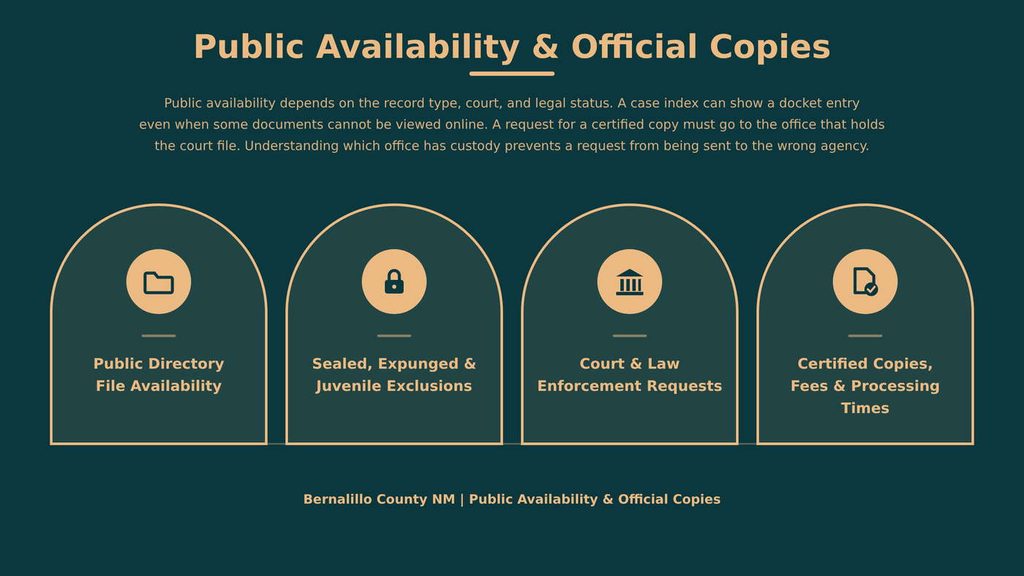
Public Directory File Availability
Publicly available criminal records often begin as entries in a public case directory. An entry can show the party name, court case number, court, case type, and status, with links to some documents when the court has posted them. The directory is not a digital filing cabinet containing every arrest report, evidence file, presentence report, or sealed exhibit. Online criminal records can be useful for a basic check by name or case number. A missing document link does not prove that the document was never filed. Some records must be pulled from court storage or requested through the clerk.
A document image on screen is also not automatically a certified copy. For a full criminal file, ask the court clerk for the records held in that specific case. For an arrest report, ask the law-enforcement agency that made the arrest. For booking or release facts, ask the jail or custody agency. Each office can issue the records it holds, but none can issue records belonging to another office.
Sealed, Expunged & Juvenile Exclusions
Some records are public, some are limited, and some are absent from an adult case index. The difference usually depends on a statute, a court order, or the type of case. A lack of search results does not by itself prove that a case never existed.
- Sealed records: A judge or legal rule can limit public viewing of a whole file or a document. The clerk may need a court order, party request, or other legal basis before releasing a sealed item.
- Expunged records: Expungement changes the public status of a qualifying record under state law. It is not an automatic result of every dismissal or acquittal. New Mexico’s Expungement of Criminal Offender Records Act, NMSA 1978 Section 31-20-211, governs qualifying requests based on an acquittal or dismissal.
- Juvenile records: New Mexico juvenile confidentiality law limits the public viewing of juvenile records. A juvenile matter may not appear in the adult criminal case index even when a later adult case does.
- Redacted documents: A public document can remain online with personal details removed. A redacted copy differs from a sealed file because the court has made a limited disclosure choice.
An expungement order may require an online index, a background-check provider, and other record holders to update their data at different times. Ask the issuing court to confirm the order and its effective date. A commercial page that still shows the case may not reflect a later court order.
Court & Law Enforcement Requests
Request court cases, dockets, dispositions, or certified copies from the relevant court clerk using the case number and party name. For arrest or police reports, contact the arresting law-enforcement agency with the report number and incident details. Request booking, detention, or release records from the responsible custody agency. For bankruptcy records, contact the appropriate federal bankruptcy court. For sealed or expunged records, contact the issuing court to ask about the applicable legal process. New Mexico law-enforcement records requests follow state public-records law, subject to legal exceptions and restrictions.
Certified Copies, Fees & Processing Times
A certified criminal record copy carries a clerk’s statement that the document is a true copy of the record held by that court. It has a different legal use from a search-result screen or an ordinary printout. The receiving agency, employer, licensing board, or court may state which type it accepts.
No criminal-copy price or fixed completion time appears in the official county details supplied for this page. Ask the clerk for the current amount tied to your request. A short certified status request can differ in cost and timing from a large file that includes many documents, so no general figure can replace the clerk’s current quote. Processing time can change when a file is not yet scanned, a document is stored away from the clerk’s office, or a request needs review. Ask for a target date and a way to check the request. Once certified, the copy gives you the court’s recorded facts as of the date it was issued.
Record Accuracy & Resolution
Accurate criminal record verification depends on matching the right person, checking the right court, and using the latest official source. Individuals can also review bankruptcy records alongside official county files for complete documentation. Common problems include similar names, cases handled in separate jurisdictions, and court events that have not reached the public index. A known case number gives the cleanest starting point because it links one party to one court file.
Differentiating Similar Name Matches
A name search can return several people who share a common name. Before combining results into one criminal history, compare every available fact. The county, case type, and case number often separate matches more clearly than a common surname.
- Full legal name: Include a middle name or initial when it is known. Record former names, suffixes, and legal name changes separately.
- Date of birth: Compare it with the identifiers in each result, even when the search form does not offer a date-of-birth field.
- Case number: Use every case number shown for the person, but keep each case tied to its own court and outcome.
- Court and location: A case in municipal court and a case in state district court belong to different indexes and can have the same party name.
- Approximate dates: An arrest date, filing date, or sentence date can separate a false match from the correct case.
- Address or other known detail: Use a past address or other reliable fact only as supporting evidence. Addresses can change and may be wrong in an old file.
Duplicate results can represent two real cases rather than a database error. One person may have separate cases in different courts, or a court may use a new case number after a later filing. Do not merge them until each case number and disposition has been checked. If one known case belongs to the intended person, the clerk can confirm details within the limits that apply to that record.
Multi-Jurisdiction System Delays
One arrest can create separate police, court, and jail records, each maintained by a different agency with its own update schedule. Recent court events or dispositions may take time to appear online. If a status seems outdated, check the case number, event date, and court name, then contact the clerk for updates. Search each relevant jurisdiction separately, since one county’s records cannot confirm information held by another court or agency.
Unlisted Criminal Record Resolution
If a criminal record does not appear, search using the full legal name, former names, and case number. Remove narrow filters and check the correct court system, as records may be held by another court or restricted from public access. Contact the relevant court clerk to confirm whether the case exists, its status, and any access restrictions. Request a certified docket or disposition if online information is missing or incorrect. For errors in official records, ask the responsible court or agency about its correction process.
Contact Information
Use these official contact details to ask which court office holds a case, request a criminal record copy, or confirm court-record procedures. For bankruptcy records, contact the appropriate federal bankruptcy court. Provide the case number and relevant names to help staff identify the correct file. Ask about applicable fees, document requirements, and processing times before submitting your request.
- Official website: https://www.bernco.gov/
- Albuquerque/Bernalillo County Government Center: 415 Silver Ave. SW, Albuquerque, NM 87102
- Main phone: (505) 468-7777
- Hours: 9 a.m. to 5 p.m.
Frequently Asked Questions
Knowing how to locate Bernalillo County criminal records helps employers, landlords, and individuals verify background information quickly. Public criminal records are accessible online, often free, and can reveal case status, charges, and sentencing details. Using the official county site or the New Mexico Judiciary index ensures accurate results and saves time.
How can I search Bernalillo County criminal records by name?
Visit the Bernalillo County Government portal and select the criminal record lookup tool. Enter the full name, middle initial, and date of birth to narrow matches. The system returns a list of case numbers, offense types, and disposition dates. Review each entry for the needed details, then click the case number for a deeper view. This method is free and updates daily.
What steps are needed to find a criminal case using a case number?
Go to the New Mexico Judiciary case index page. Choose the “Case Number Search” option and type the exact Bernalillo County case number. The search displays the case title, filing date, and current status. Click the link to view charge information, court dates, and any sentencing data. This approach bypasses name variations and delivers precise results.
Can I obtain a certified copy of a Bernalillo County criminal record?
Yes. After locating the case online, note the case number and contact the Bernalillo County Clerk’s Office at (505) 468‑7777. Request a certified copy, pay the standard fee, and provide a valid ID. Processing typically takes 3‑5 business days. Certified copies are accepted for employment checks, licensing, and legal matters.
How do I search criminal records by date of birth when the name is unknown?
Use the “Advanced Search” feature on the county’s public database. Enter the birth date and select “All Records.” The system lists any entries matching that date, including arrests and convictions. Review each result for additional identifiers such as middle name or address to confirm the correct individual. This method helps when only limited personal data is available.
What should I do if a Bernalillo County criminal record appears outdated or missing?
First, verify the spelling and date of birth used in the search. If the record still does not appear, contact the Bernalillo County Court Records Division. Request a manual check for sealed, expunged, or archived files. Provide any known case numbers or court dates to speed the inquiry. The division can confirm whether the record is unavailable or has been removed from public view.